
Ground-Mounted Solar Panels - Edinburgh 2026 Guide
Picture this: you're stood in your garden in Morningside, watching your neighbour's Georgian roof adorned with solar panels, and wondering if there's another way. Maybe your roof faces north towards the Pentlands, or perhaps it's listed and untouchable. Ground-mounted solar panels could be Edinburgh's answer, offering 25-35% better performance than typical roof installations while respecting our city's heritage. Yes, they cost more upfront (£8,000-£12,000 for residential systems) and usually need planning permission, but they're perfect for properties with unsuitable roofs or generous garden space.
With energy bills still causing headaches across the Lothians, more Edinburgh residents are exploring ground-mounted options. Whether you're in Corstorphine with a large garden, running a business in Leith with unused land, or dealing with New Town conservation restrictions, this guide covers everything you need to know about ground-mounted solar panels in Edinburgh for 2026.
Table of Contents
What Are Ground-Mounted Solar Panels?
Key Differences from Roof-Mounted Systems
Types of Ground-Mounted Solar Panels
Planning Permission & Regulations in Edinburgh
Ground-Mounted Solar Panel Installation Process
Ground-Mounted Solar for Homes vs Businesses
What Are Ground-Mounted Solar Panels?
Ground-mounted solar panels are photovoltaic (PV) systems installed at ground level on frameworks or mounting structures, rather than fixed to your rooftop. In a typical setup, panels are attached to metal frames or poles anchored into the ground (often with concrete foundations or ground screws) to ensure stability against Edinburgh's notorious winds.
This allows the panels to be tilted at optimal angles (usually around 30-40° in Scotland) and oriented for maximum sun exposure, which can increase their efficiency compared to roof-mounted systems. Ground-mounted solar panels are commonly used in large-scale solar farms across Scotland and commercial installations, but they're increasingly suitable for residential properties with ample open space.
The key advantage? Unlike roof panels that must work with whatever angle and direction your roof provides, ground-mounted solar panels can be positioned perfectly for Edinburgh's latitude and weather patterns. This means optimal south-facing alignment and tilt adjustment to maximise solar gain throughout the year – particularly important given Scotland's lower sun angles.

Key Differences from Roof-Mounted Systems
Understanding how ground-mounted solar panels differ from traditional roof installations helps you make an informed decision about what's right for your Edinburgh property.
Optimal Placement and Performance
The biggest advantage is positioning freedom. Because they aren't constrained by roof orientation or pitch, ground-mounted solar panels can be positioned for the best tilt and orientation to capture sunlight. Your Georgian terrace might face east or west, but your ground array can face due south to capture maximum sunlight, often yielding higher energy output.
In fact, being able to angle panels ideally and keep them well-ventilated makes them more efficient. Studies show ground systems can produce 25-35% more electricity than typical rooftop panels due to these factors. In Edinburgh's climate, this flexibility can make a substantial difference to your energy generation, especially during our shorter winter months.
Space and Accessibility Considerations
Roof-mounted panels utilise otherwise unused roof space, preserving your garden for other uses. In contrast, ground-mounted solar panels will occupy part of your land, typically 20-30 square metres for a 4kW system. For homeowners, this means sacrificing some garden space.
However, ground arrays are significantly easier to access for cleaning, inspection, and maintenance since they're at ground level. You won't need ladders or roof access to wash panels or check connections. While modern solar panels are generally low-maintenance, ground systems make any necessary upkeep much simpler and safer, particularly important in Edinburgh where our frequent rain actually helps keep panels clean naturally.
Installation and Planning Requirements
With a roof install, the building's structure supports the panels, whereas a ground mount requires building a new support structure from scratch. This framework adds to installation complexity but allows for more precise positioning.
Generally, roof installations are straightforward if the roof is suitable, and they typically fall under permitted development. Ground-mounted solar panels often trigger planning permission due to their size and separate structures. This adds paperwork and potential delays, though Edinburgh Council generally supports renewable energy projects, particularly when they're sensitively designed to complement our city's character.

Pros and Cons
Let's be honest about what you're signing up for with ground-mounted solar panels. Like any significant home improvement, there are clear advantages and some considerations you'll need to weigh up.
The Compelling Advantages
Superior Performance Potential. Ground-mounted solar panels consistently outperform roof installations when properly positioned. You're looking at optimal south-facing alignment, perfect tilt angles for Edinburgh's latitude, and excellent cooling from airflow underneath. This can significantly reduce your home's dependence on grid electricity – particularly valuable given Scotland's ambitious net-zero targets.
Maintenance Made Simple. Ground arrays let you perform routine maintenance safely from ground level. This accessibility often leads to better-maintained systems and better long-term performance. You can easily brush off autumn leaves, check connections, and monitor performance without safety concerns.
Perfect for Heritage Properties. If your Edinburgh home has a north-facing roof, structural concerns, or planning restrictions (common in our many conservation areas), ground-mounted solar panels offer a viable alternative. Ground systems are also ideal if you've maximised roof space but want additional capacity, or if you're considering adding battery storage for complete energy independence.
Expansion and Flexibility. Unlike roof space which is fixed, ground installations can often be expanded if your energy needs grow or you want to add battery storage later. This modular approach makes ground-mounted systems particularly attractive for properties planning future electric vehicle charging or heat pump installations.
The Practical Considerations
Land Requirements The most obvious consideration for many Edinburgh properties is space. City gardens aren't always generous, and dedicating 20-30 square metres to solar panels might not work for every situation. Properties around Edinburgh's outskirts in areas like Balerno or Currie have a clear advantage here.
Higher Upfront Investment Ground systems typically cost 25-35% more than equivalent roof installations due to additional mounting infrastructure, more extensive cabling and trenching, and ground preparation work. However, the improved performance often justifies this premium over the system's 25+ year lifespan.
Planning Permission Process Unlike most roof installations, you'll likely need planning permission from City of Edinburgh Council. This adds time (typically 8-12 weeks), modest costs, and requires some paperwork. The good news? Solar applications are usually well-received when properly presented, especially when they respect Edinburgh's historic character.
Visual Impact and Security Ground arrays are more visible and potentially vulnerable to damage compared to roof installations. Some homeowners address this with strategic landscaping or discrete fencing, which adds to the overall project cost.
Types of Ground-Mounted Solar Panels
Not all ground-mounted solar panels are created equal. Understanding your options helps ensure you choose the right system for your Edinburgh property's specific needs and budget.
Fixed-Tilt Systems
Fixed-tilt ground-mounted solar panels represent the sweet spot for most Edinburgh installations. These systems position panels at a static angle – typically around 35° for our latitude – facing due south for optimal year-round performance.
Why they work well in Edinburgh:
Simple, proven technology with minimal moving parts
Lower maintenance requirements and higher reliability
Cost-effective for residential and small commercial installations
Reliable performance in our mix of sunny and overcast conditions
The mounting structure is typically constructed from galvanised steel or aluminium, designed to withstand Edinburgh's weather patterns including occasional high winds and snow loading from the Pentlands. Most fixed systems come with 25-year warranties covering both panels and mounting hardware.
Solar Tracking Systems
Solar tracking systems represent the premium end of ground-mounted solar panels. These motorised systems follow the sun's path throughout the day, potentially boosting energy output by 20-40% compared to fixed systems.
However, these gains come with notable trade-offs. Trackers are more complex and expensive; a single-axis tracker mechanism might cost £2,500 on its own. In Edinburgh's climate with frequent overcast conditions, the advantage of tracking is less pronounced than in sunnier regions. The additional complexity and maintenance requirements mean tracking systems are typically reserved for larger commercial installations. For most residential applications, ground-mounted installations offer better value with fixed-tilt systems.
Pole-Mounted Systems
For Edinburgh properties with limited ground space, pole-mounted systems offer a compact alternative. These install panels on a single robust pole, typically accommodating 2-8 panels depending on the pole's strength and local wind conditions from the Forth.
Pole mounts work particularly well for small installations powering specific equipment, properties with partially shaded areas, or locations where aesthetic impact needs to be minimised, perhaps in sensitive areas near Edinburgh Castle or Holyrood Palace. The main limitation is capacity; you won't power a whole house with a pole-mounted system.

Is Your Property Suitable?
Before getting excited about ground-mounted solar panels, it's worth honestly assessing whether your Edinburgh property is a good candidate.
The Space Equation
A typical 4kW ground-mounted solar panel system needs approximately 20-30 square metres of unshaded space – roughly the size of a large patio. But it's not just about total area. The space needs to be relatively rectangular and positioned where it won't be shaded by your house, trees, or neighbouring buildings.
Quick space assessment checklist:
Measure your available area (length × width)
Check for shade patterns throughout the day, particularly 9am-3pm
Consider seasonal shade from deciduous trees
Account for the 5-metre boundary setback requirement
Sun Exposure and Site Conditions
Edinburgh receives about 950-1000 kWh per square metre annually, which is sufficient for good returns when panels are properly positioned. Your ideal site receives unobstructed sun between 9am and 3pm year-round, particularly during spring and summer months.
Red flags for Edinburgh properties:
North-facing slopes towards the Pentlands
Areas overshadowed by tenements or large buildings
Boggy or flood-prone ground that complicates mounting
Extremely sloped terrain requiring expensive levelling
Property Type Considerations
Ideal candidates:
Detached houses with generous gardens in areas like Corstorphine or Morningside
Rural properties around Edinburgh's outskirts with ample land
Properties with unsuitable roofs (orientation, structural issues, listed status)
Households with high electricity consumption (heat pumps, EVs, home businesses)
More challenging situations:
Typical New Town flats with shared or no garden space
Properties where space is at premium for other activities
Rental properties where landlord permission isn't guaranteed
Planning Permission & Regulations in Edinburgh
Navigating planning permission for ground-mounted solar panels in Edinburgh requires understanding both Scottish regulations and local policies.
Permitted Development: Understanding the Limits
Under permitted development rights, you can install ground-mounted solar panels without planning permission, but only if they meet strict criteria:
Maximum size: 9 square metres (roughly 3-4 panels)
Height limit: No more than 4 metres above ground level
Boundary distance: At least 5 metres from property boundaries
Quantity restriction: Only one array per property
Heritage restrictions: Not permitted on listed building grounds or in conservation areas
For most Edinburgh homeowners wanting meaningful solar generation, these restrictions are too limiting, particularly in our many conservation areas, including the Old Town, New Town, and Stockbridge.
Planning Permission: The Standard Route
Most practical ground-mounted solar panel installations in Edinburgh require planning permission through City of Edinburgh Council. The encouraging news is that the council generally supports renewable energy projects when appropriately designed and sensitive to Edinburgh's heritage.
The application process involves:
Planning application submission
21-day neighbour consultation period
Council assessment and decision (typically 8-16 weeks)
What Edinburgh planners consider:
Visual impact on the area's character and historic setting
Any impact on surrounding properties
Heritage concerns (particularly crucial in World Heritage Site areas)
Technical appropriateness of the installation
Conservation Areas and Listed Buildings
Edinburgh has numerous conservation areas where additional scrutiny applies. In these areas, planners pay particular attention to public visibility, design quality, and character preservation of our UNESCO World Heritage Site.
Interestingly, ground-mounted solar panels sometimes receive easier approval than roof installations in conservation areas, particularly when they're discrete and well-screened. The key is demonstrating how the installation respects Edinburgh's historic character.
Building Regulations and Standards
Beyond planning, ground-mounted solar panels must meet building regulations and electrical safety standards. Understanding the solar PV planning process is essential for Edinburgh installations:
Electrical installation must comply with BS 7671 wiring regulations
Mounting systems must handle local wind and snow loads (important given Edinburgh's exposure)
MCS certification is required for Smart Export Guarantee payments
Grid connection must be approved by the local Distribution Network Operator
Using MCS-accredited installers ensures all regulatory requirements are met.

Ground-Mounted Solar Panel Installation Process
Understanding the installation process helps set realistic expectations for your ground-mounted solar panel project.
Pre-Installation Assessment
Professional installation begins with comprehensive site assessment:
Ground conditions analysis (important given Edinburgh's varied geology)
Underground utilities location using detection equipment
Solar resource mapping and shade analysis
Detailed system design with panel layout and electrical connections
Installation Phases
Site preparation (1-2 days):
Precise marking of the array footprint
Careful removal and storage of turf or vegetation
Foundation installation using either concrete footings or ground screws
Ground screws have become popular in Edinburgh's varied soil conditions, offering excellent stability with minimal ground disturbance.
System installation (2-3 days):
Mounting structure assembly with precision alignment
Panel installation with secure attachment using approved hardware
DC wiring between panels in optimised configurations
Inverter installation and AC connection to your electrical system
Underground cable routing through conduits
Testing and commissioning (1 day):
Comprehensive electrical safety testing
Power output verification and system optimisation
MCS certification and documentation
System monitoring setup and user training
Timeline and Weather Considerations
The total project typically takes 8-15 weeks from initial survey to completion, including planning permission time. Weather can extend timelines, particularly during Edinburgh's wetter months when ground conditions may delay foundation work.
Costs, Incentives, and ROI
Understanding the complete financial picture is crucial for making an informed decision about ground-mounted solar panels.
Upfront Investment
Ground-mounted solar panels require higher initial investment than roof installations:
Residential systems (3-6kW):
Roof-mounted equivalent: £5,000-£8,000
Ground-mounted: £8,000-£12,000
Premium: 25-35% higher upfront cost
Commercial systems:
10kW system: approximately £25,000-£30,000
20kW system: approximately £40,000-£50,000
Current Government Incentives
Zero VAT on solar installations (until March 2027): This energy-saving product tax relief saves 20% on total installation costs – £2,000 on a typical £10,000 system.
Smart Export Guarantee (SEG) payments: Sell excess electricity back to the grid at rates varying from 3-15p per kWh, providing £100-£300 annual income for typical domestic systems. The Energy Saving Trust provides detailed guidance on maximising these payments.
Business tax advantages: Companies can write off 100% of installation costs against profits through the Annual Investment Allowance, providing effective 19-25% cost reduction.
Return on Investment Analysis
Edinburgh's solar economics have improved with rising energy prices:
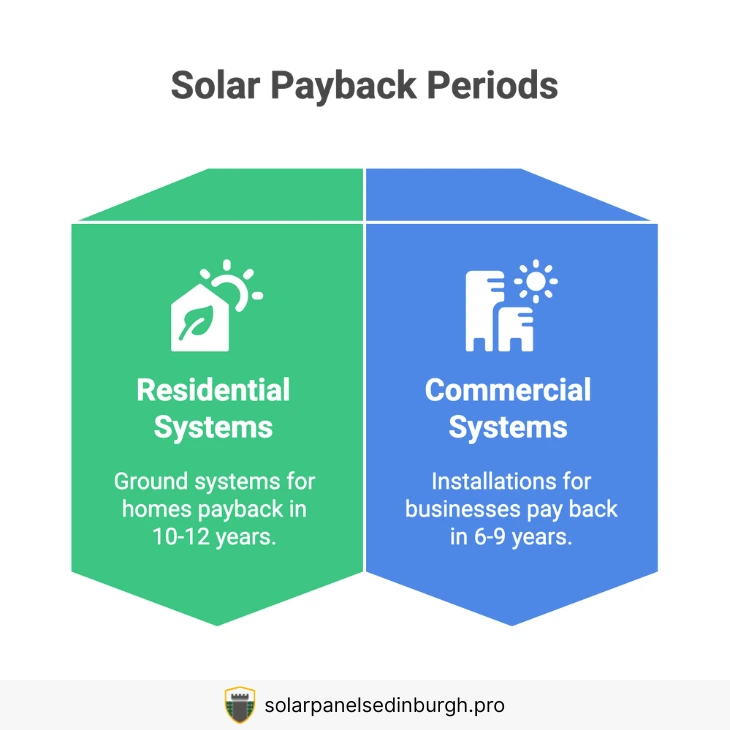
Typical payback periods:
Residential ground systems: 10-12 years
Commercial installations: 6-9 years
High-consumption properties: 8-10 years
Annual savings for typical 4kW residential system:
Self-consumption savings: £600-£900
SEG export income: £80-£200
Total annual benefit: £680-£1,100
Well-positioned ground arrays in Edinburgh typically generate 15-25% more than suboptimal roof installations, directly improving payback periods.
Ground-Mounted Solar for Homes vs Businesses
The decision to install ground-mounted solar panels varies significantly between homeowners and business owners.
Scale and Energy Demand
Residential applications typically involve 3-8kW systems designed to offset household consumption (average 3,400kWh annually in Edinburgh).
Commercial installations operate on much larger scales, from 20kW to several hundred kW, matching business energy profiles and operational requirements.
Financial Drivers
Homeowners benefit from:
Immediate bill reduction (£600-£1,000+ annually)
SEG export income (£100-£300 yearly)
VAT relief and potential property value increases
Protection against future energy price rises
Businesses gain:
Operational cost reduction with immediate cash flow impact
Substantial tax advantages through capital allowances
Higher self-consumption rates (70-90% vs 30-50% residential)
Corporate responsibility and competitive advantages
Usage Patterns
Edinburgh families are typically away during peak solar hours, reducing self-consumption to 30-50%. Commercial operations generally consume power during daylight hours, potentially using 70-90% of generated electricity on-site, dramatically improving returns.
Final Thoughts: Is Ground-Mounted Solar Right for You?
For most Edinburgh homeowners, roof-mounted solar remains the sensible first choice. However, ground-mounted solar panels deserve serious consideration if:
Your roof is unsuitable (orientation, condition, heritage restrictions)
You've maximised roof space but want more capacity
Energy consumption substantially exceeds average
You have generous garden space available
For Edinburgh businesses with available land, the case is often compelling due to better returns, tax advantages, and higher self-consumption rates.
Critical Success Factors
Ground-mounted solar panels work best with:
At least 30m² of unshaded, south-facing space
Energy consumption exceeding 4,000kWh annually
Long-term property occupation planned (10+ years)
Acceptance of planning permission requirements
The Investment Perspective
Think of ground-mounted solar panels as a 25+ year investment in energy independence. The higher upfront cost is offset by superior performance, easier maintenance, and greater flexibility. With current government incentives and Edinburgh's reasonable solar resource, properly sized systems typically achieve payback within a decade while providing decades more of reduced energy costs.
Ready to explore ground-mounted solar panels for your Edinburgh property? Our experienced team can assess your site, navigate planning requirements, and design a system that maximises your investment. Whether you're in Leith, New Town, Old Town, Stockbridge, West Edinburgh, East Edinburgh, or South Edinburgh, we'll help harness Edinburgh's solar potential while respecting our city's unique character. Learn more about our approach to solar installations or contact us today for a no-obligation consultation.

FAQs About Ground-Mounted Solar Panels in Edinburgh
How long do ground-mounted solar panels last in Edinburgh's climate?
Ground-mounted solar panels have the same lifespan as roof-mounted systems, typically 25-30 years of productive life, often longer. Edinburgh's climate is actually quite favourable for solar panel longevity. Our moderate temperatures, regular rainfall (which helps keep panels clean), and relatively low UV intensity compared to hotter climates mean panels often exceed their warranty specifications.
The key components have different lifespans: panels themselves often produce 80%+ of original output after 25 years, whilst inverters typically need replacement after 12-15 years. The mounting structure, when properly galvanised and installed, can last the system's entire life. Ground installations may actually last longer than roof systems because they run cooler and are more accessible for maintenance and repairs.
Can I expand my ground-mounted solar system later?
Yes, this is one of the key advantages of ground-mounted solar panels over roof installations. Provided you have additional suitable space and comply with planning regulations, expansion is typically straightforward.
However, there are considerations: you'll need to ensure your existing inverter can handle additional capacity or be upgraded. The mounting structure should be designed with expansion in mind (something professional installers plan for). You'll also need to check whether expanded capacity requires a new planning application in Edinburgh, significant expansions often do, particularly in conservation areas.
Many of our Edinburgh clients start with a basic system and expand as their energy needs grow (perhaps adding an electric vehicle or heat pump). The modular nature of ground-mounted systems makes this much more practical than trying to find additional roof space.
What happens if I need to sell my property?
Ground-mounted solar panels generally add value to Edinburgh properties, though the impact varies by buyer preferences and system age. Solar installations typically increase property appeal, particularly among environmentally conscious buyers, and the energy cost savings are increasingly attractive selling points – especially important in Edinburgh's competitive property market.
The key is proper documentation: ensure you have all MCS certificates, planning permissions, and warranty documentation for prospective buyers. Well-maintained systems with remaining warranty periods are viewed more favourably than older installations nearing end-of-life.
Unlike roof systems that are essentially permanent fixtures, ground-mounted solar panels could theoretically be relocated, though this is rarely practical or cost-effective. Most buyers view established ground systems as valuable infrastructure, similar to a conservatory or outbuilding.
How do ground-mounted panels perform during Edinburgh winters?
Edinburgh winters actually favour ground-mounted solar panels in several ways. The panels can be positioned at optimal angles for winter sun capture (slightly steeper than summer optimum), and they benefit from reflected light off snow or frost when it occurs, particularly useful given our proximity to the Pentlands.
Ground arrays are also easier to clear of snow accumulation, though Edinburgh rarely experiences enough snowfall to significantly impact generation. The bigger winter challenge is shorter daylight hours and frequent overcast conditions – but this affects all solar installations equally.
Interestingly, solar panels are more efficient in cooler temperatures, so Edinburgh's mild winters can produce surprisingly good results during clear, cold days. Annual generation is obviously lower than summer months, but winter performance often exceeds expectations, especially with optimal positioning that ground mounting allows.
What maintenance do ground-mounted solar panels need?
Ground-mounted solar panels require minimal maintenance, but their accessibility makes what's needed much easier than roof installations. Regular maintenance includes:
Annual tasks:
Visual inspection of panels, mounting, and electrical connections
Cleaning (though Edinburgh's frequent rainfall handles much of this naturally)
Vegetation management around the array to prevent shading
Inverter performance monitoring
Occasional requirements:
Tightening mounting bolts after weather events
Replacing individual panels if damaged (rare but possible)
Inverter replacement after 12-15 years
Electrical connection inspection
The beauty of ground systems is you can perform most maintenance safely yourself. No ladders, no roof access concerns – just walk out to your array for routine checks. Professional maintenance services are available if you prefer hands-off ownership, but they're less essential than with roof installations.
Most Edinburgh ground installations need professional attention only for inverter issues or storm damage, and even then, everything's easily accessible for repair work.