
Is the Government Making Solar Panels Mandatory in Edinburgh?
Solar energy policy has been making headlines across the UK, and Edinburgh homeowners are right to be asking questions. England has locked in legislation making panels a legal requirement on most new homes from 2027, and the news has naturally prompted people north of the border to wonder: does that apply here too?
Quick take: Solar panels are not mandatory on new homes in Edinburgh, and no current Scottish legislation plans to make them so. The Future Homes Standard, which introduces mandatory solar on new English homes from March 2027, does not apply to Scotland. Building standards here are a devolved matter. Scotland's New Build Heat Standard, in force since April 2024, makes clean heating mandatory in new buildings but says nothing about solar PV. A Passivhaus equivalent standard is under review, but no mandatory solar proposal has been put forward as part of it. Existing homes are entirely unaffected.
Table of Contents
What Are the Current Rules on Solar Panels for New Homes in Scotland?
What Is the Future Homes Standard, and Does It Apply to Edinburgh?
What Scotland Has Made Mandatory: The New Build Heat Standard
Scotland's Next Step: The Passivhaus Equivalent Review
Does Any of This Make Solar Mandatory in Edinburgh?
What This Means for Edinburgh Homeowners and Developers
Final Thoughts on Solar Panels and Government Policy in Edinburgh
What Are the Current Rules on Solar Panels for New Homes in Scotland?
As of mid-2026, there is no requirement for panels on new homes anywhere in Scotland. Building standards here are a devolved matter, set by the Scottish Government rather than Westminster. Section 6 of the Scottish Building Standards covers energy performance for new buildings, but it doesn't prescribe specific technologies to meet those targets.
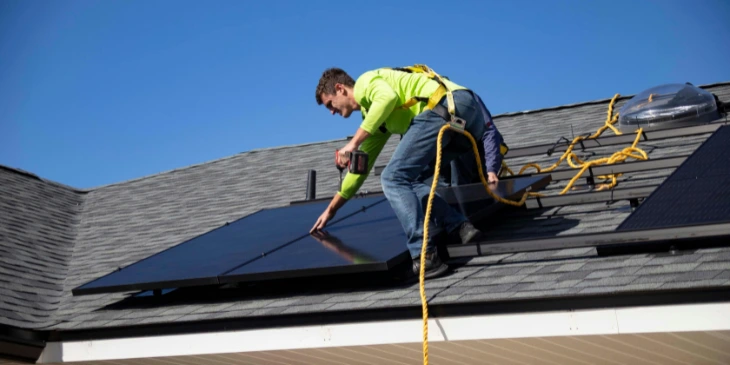
Many new Edinburgh developments do include solar PV. Builders in areas such as East Edinburgh and Leith fit them voluntarily to improve energy ratings and attract buyers who care about running costs. But that's a developer's commercial decision, not a government rule. Official guidance from the UK government has consistently taken a technology-neutral approach, giving builders the freedom to cut carbon without being directed towards any one solution. Scotland's current position reflects the same thinking. Panels are a strong choice, but they're not a legal requirement on any new Scottish home right now.
What Is the Future Homes Standard, and Does It Apply to Edinburgh?
The Future Homes Standard (FHS) is the English government's new energy performance framework for homes built in England. Confirmed in March 2026 and coming into force in March 2027, it makes PV effectively mandatory on most new English homes alongside low-carbon heating and high insulation standards. According to a Parliament statement from March 2026, new homes in England will emit at least 75% less carbon than homes built to 2013 standards.
It does not apply here. It does not apply anywhere in Scotland. Building regulations are devolved, and what the English government mandates for new homes in Manchester or Milton Keynes carries no legal weight in Scotland. The FHS is the reason this question is being asked so often right now, but for Edinburgh homeowners and developers, it simply isn't the relevant framework.
What Scotland Has Made Mandatory: The New Build Heat Standard
Scotland hasn't been standing still. The New Build Heat Standard (NBHS), in force since April 2024, prohibits direct emissions heating systems in all new Scottish buildings. Gas and oil boilers are no longer permitted as mains heating in any new home. Clean heating, in most cases a heat pump, is now a government-mandated requirement for every new build.
The NBHS was updated in January 2025, formally permitting bioenergy systems such as wood burning stoves and peat heating in all new homes, and confirming that any form of secondary heating is allowed. The core rule hasn't moved: fossil fuel mains heating is out, permanently.
This is a real shift for the city's new-build sector. In growth areas such as West Edinburgh and South Edinburgh, where residential development continues at pace, every new home warranted since April 2024 must include clean heating as a legal requirement. That is already live.
Solar panels, however, are not part of what the NBHS makes mandatory. The standard covers heating systems, not on-site electricity generation. These are two distinct requirements, and that distinction matters for anyone planning a new build.
Scotland's Next Step: The Passivhaus Equivalent Review
Beyond the NBHS, the Scottish Government is reviewing its wider energy standards for new buildings. In December 2022, ministers committed to legislation for a Scottish equivalent to the Passivhaus standard, one of the most demanding energy performance frameworks used internationally.
A working group was convened in June 2023, bringing together industry bodies, housing associations, and energy networks. The review covers both new homes and non-domestic buildings, focusing on building fabric performance, delivered energy demand, and construction quality assurance.
No confirmed date has been set for when this becomes law. Critically, the review centres on the building envelope: insulation, airtightness, and energy demand. No mandatory PV requirement has been proposed as part of it.
For developers planning schemes in New Town or Stockbridge and Canonmills, this review is worth tracking. When the Passivhaus equivalent eventually lands, it will reset the minimum standard for all new Scottish homes, and the energy systems within those homes will need to align with it.
Does Any of This Make Solar Mandatory in Edinburgh?
To be direct: no. Neither the NBHS nor the Passivhaus equivalent review introduces a mandatory solar PV requirement for new homes here. The FHS does, but that is English law and stops at the border.
Scotland's trajectory is clearly towards cleaner, more energy-efficient new homes. Mandatory clean heating is already in place. Higher fabric standards are coming. But the Scottish Government has not placed panels on the mandatory list, and nothing in the current Passivhaus review suggests that is imminent.
There is a practical point worth noting. Homes built to near-Passivhaus performance levels have very low residual energy demand. That makes solar PV an excellent complement, even without a government mandate. In Old Town new builds or developments in Stockbridge and Canonmills, pairing mandatory clean heating with panels and solar battery storage gets homeowners to genuine energy independence ahead of whatever the next standard brings. The government isn't forcing that combination in Scotland, but the logic for it is already there.
What This Means for Edinburgh Homeowners and Developers
For anyone buying a new home in the city, solar panels are not a mandatory feature. Whether a development comes with them depends entirely on the builder.
For developers building across the city, the NBHS clean heating requirement is already live and non-negotiable. Adding solar voluntarily on top of that is a strong commercial decision: it lifts the energy performance certificate rating, reduces occupier running costs, and positions the property well ahead of wherever the Passivhaus equivalent takes the standards. For guidance on building regulations compliance for a specific site, our accredited installers can help you plan the right approach.
Existing homeowners across East Edinburgh, Leith, and beyond are not covered by any of the above. The NBHS applies to new builds only, and the future Passivhaus standard will do the same. But installing panels now delivers real benefits regardless: lower bills, reduced grid dependence, and a better energy rating. Solar maintenance and repair services are also available through our network for any existing system that needs attention.
Final Thoughts on Solar Panels and Government Policy in Edinburgh
Scotland is not England, and Edinburgh's regulatory picture is not English. The Future Homes Standard makes solar panels mandatory on new English homes from 2027. That law does not cross the border.
What Scotland has done is meaningful in its own right. Clean heating is government-mandated for every new home. Higher energy fabric standards are being developed. Both point in one direction: lower-carbon, more energy-independent new homes. Going solar fits naturally within that trajectory, even where it isn't compulsory.
For existing homeowners across West Edinburgh, South Edinburgh, or anywhere else in the city, the case doesn't rest on legislation. It stands on its own. Solar Panels Edinburgh connects you with vetted local installers. Get in touch to talk through your options with a vetted local installer.
Solar Panels and Government Policy in Edinburgh FAQs
Are solar panels mandatory on new homes in Edinburgh?
No. Panels are not mandatory on new homes in Scotland. Building standards here are devolved from Westminster, and no current Scottish legislation requires solar PV on new builds.
Does the Future Homes Standard apply to Edinburgh?
No. The Future Homes Standard is an English government policy coming into force in March 2027. It applies to new homes built in England only. Scotland operates under its own building standards framework and is not covered by the FHS.
What has the Scottish Government made mandatory for new homes?
Scotland's New Build Heat Standard, in force since April 2024, makes clean heating mandatory in all new Scottish buildings. Gas and oil boilers are no longer permitted as mains heating systems in new homes. Solar panels are not part of this requirement.
What is the Scottish Passivhaus equivalent?
In December 2022, the Scottish Government committed to legislation for a Scottish equivalent to the Passivhaus standard. A working group is reviewing energy standards for new homes and non-domestic buildings, focusing on fabric performance and energy demand. No mandatory solar requirement has been proposed as part of this process.
Should Edinburgh homeowners still consider going solar?
Yes. It's not mandatory here, but it makes strong practical sense regardless. Lower bills, a better energy performance rating, and reduced reliance on the grid are real benefits whether or not the government requires it. Solar Panels Edinburgh connects you with vetted local installers to explore your options.
Does any of this affect existing homes?
No. Both the NBHS and any future Passivhaus equivalent apply to new builds only. Existing homeowners are not required to change their heating systems or retrofit panels under current Scottish legislation. Many choose to go solar voluntarily for the long-term financial benefits.