
Are Parapet Walls a Hindrance to Solar? - Edinburgh
Walk through Leith, Marchmont, or along the Canongate and you'll notice something shared by a huge number of Edinburgh's flat-roofed buildings: parapet walls. These low perimeter walls are practically a defining feature of the city's roofscape, from Georgian commercial blocks in the New Town to post-war residential properties across South and West Edinburgh. If you're thinking about solar, the question of whether those walls will cause headaches is a fair one.
Quick take: Parapet walls create a shading challenge, but they also bring real advantages including wind protection and easier planning compliance. With correct setbacks, the right mounting system, and panel-level optimisers where needed, flat roofs with parapet walls across Edinburgh are regularly fitted with well-performing solar arrays.
Table of Contents
What Exactly Is a Parapet Wall?
Is Solar Installation Possible on Flat Roofs With Parapet Walls?
Shading, Energy Output, and Modern Technology
Mounting Options for Flat Roofs With Parapet Walls
Costs, Maintenance, and Planning
What Exactly Is a Parapet Wall?
A parapet wall is the short vertical wall running around the perimeter of a flat roof, terrace, or balcony. In Edinburgh, they're found on Victorian tenements in Stockbridge, sandstone commercial buildings across South Edinburgh, and older flatted properties throughout East and West Edinburgh. They exist for fall prevention, drainage management, fire compartmentalisation, and concealing rooftop plant from the street.
That last function matters more in Edinburgh than almost anywhere else in the UK. As a UNESCO World Heritage city, visual impact on the historic streetscape is taken seriously by planners. Parapet walls are an asset in this respect, keeping rooftop equipment out of sight from street level.
For solar, the walls create two competing effects. They introduce a shading risk, particularly during Edinburgh's long winters when the sun sits low in the sky. But they act as a windbreak too, which is no small thing given the city's genuine North Sea exposure. Getting the best from a parapet roof means understanding both sides of that picture.
Is Solar Installation Possible on Flat Roofs With Parapet Walls?
Yes, and it happens regularly across the city. Properties in Leith, the Old Town, and residential streets throughout West Edinburgh with this type of roof are fitted with solar arrays all the time. When designed properly, results are often excellent.
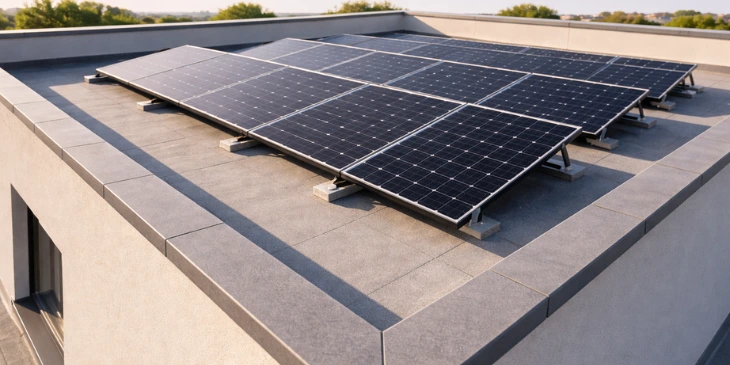
The standard approach is mounting panels on the flat roof surface with enough distance from the parapet walls to stay clear of their shadow. The commonly used rule is a setback of 1.5 to 2 times the wall's height. A 1 metre parapet means keeping panels at least 1.5 to 2 metres back. On roofs with particularly tall walls, designers sometimes apply a 3 times multiplier to ensure shading is avoided during the winter solstice, when sun angles are at their lowest.
Spanning beam systems offer an alternative on narrower buildings. Lightweight aluminium beams bridge from one parapet to the other and panels sit above the roof surface entirely, with no weight transferred to the membrane. This suits older Edinburgh properties where the flat roof may not be rated for added load, though the parapets must be structurally sound enough to carry the system.
One thing to avoid entirely: bolting racking through the roof membrane without proper waterproofing. This installation guidance makes clear it commonly falls outside building code. On a tenement block where a leaking roof can damage multiple flats below, approved fixing methods and thoroughly sealed penetrations are the only acceptable standard.
Key Design Considerations for Parapet Walls
Setback from the walls. This is the most important variable on a parapet roof. Get it wrong and shading will drag down output, particularly through winter. A setback of 1.5 to 2 times the wall height is the working minimum; on south-facing parapets, err towards the larger end given how far shadows stretch at Edinburgh's latitude.
Row spacing. Panels can shade each other if rows sit too close together. Around 1 metre between rows is the standard allowance for flat roof arrays at Edinburgh's latitude.
Tilt angle. Most flat roof systems use a tilt of 5 to 15 degrees, balancing energy yield against wind resistance. Too flat and panels collect dirt and standing water; too steep and wind uplift increases sharply. A flat roof also allows flexible orientation: due south for maximum annual output, or an east-west split to spread generation more evenly through the day.
Wind loading. Edinburgh's coastal position means wind loading deserves careful attention. A parapet of around 3 feet or more reduces uplift forces at the roof edge, but it doesn't replace a proper wind load calculation.
Structural capacity. Ballasted systems add typically 20 to 30 kg per square metre. On Victorian-era tenements and older commercial buildings, a structural engineer should assess load capacity before installation begins.
Drainage. Parapet-edged roofs drain internally via outlets or scuppers. Panel supports must not obstruct these routes. Edinburgh's rainfall makes keeping drainage clear a genuine maintenance priority, not an afterthought.
Shading, Energy Output, and Modern Technology
Shading is where parapet walls cause the most damage, and it's worth understanding why. If a single cell within a 36-cell panel is shaded, the output of that panel can drop by up to 75% in a string-inverter system. That's caused by the way traditional string wiring restricts current to the lowest-performing panel in the chain.
At 56°N, Edinburgh gets around 1,340 to 1,400 hours of sunshine annually. Summers are productive; winters bring short days with a sun that barely clears the rooftops. Research into parapet shading shows that a 1 metre high perimeter wall typically needs a 3 metre setback to keep panels clear of its shadow at the winter solstice. A south-facing parapet can cast a surprisingly long shadow on a December afternoon.
Panel-level optimisers and microinverters have changed the picture considerably, though. These devices let each panel operate independently, so a shaded panel no longer pulls the rest of the string down with it. Where some shading is unavoidable, grouping affected panels into a separate string from the unshaded central zone limits the overall loss.
Panels mounted vertically on the parapet face are possible but produce 15 to 25% less annual energy than a correctly tilted panel on the roof surface. Studies also show this configuration can increase wind stress on the wall by up to 40%. For most Edinburgh properties, keeping panels on the flat roof and using the parapet as a windbreak is clearly the better option.
Mounting Options for Flat Roofs With Parapet Walls
Ballasted racking is the most common choice. Panels sit on a frame weighted by concrete blocks, with no penetrations through the roof membrane. Because the parapet reduces wind exposure at the edges, less ballast is typically needed. Structural sign-off on load capacity is still required.
Mechanical (attached) racking anchors directly into the roof structure. This suits sites where parapets are low or the building is particularly exposed. As this flat roof overview explains, attached systems are often preferred where no perimeter walls exist to reduce wind speed. Every penetration must be flashed and sealed.
Parapet-bridging beams span between opposite walls, suspending panels above the roof surface without touching the membrane. On narrower Edinburgh buildings where usable roof area is limited, this maximises panel count. The parapet walls become load-bearing for the system, so a structural assessment is non-negotiable.
Roof stand frames raise panels on adjustable feet to lift the array above the shadow line of a taller parapet. Concentrated footing loads need careful checking on older buildings.
Vertical parapet mounts are a niche option only. The output penalty, wind stress risk, and engineering demands make them unsuitable for most installations. For a full roof assessment, contact the team at Solar Panels Edinburgh.
Costs, Maintenance, and Planning in Edinburgh
What does it cost? Flat roof solar in Edinburgh carries a modest premium over pitched roof installations, mainly because of mounting hardware. A 4 kW system without battery storage typically comes in at £6,000 to £7,500, or £1,250 to £1,500 per kW. Flat roofs are faster to work on than pitched ones, which keeps labour costs reasonable. If a structural engineer is required, factor in their fees early. Adding battery storage and registering for the Smart Export Guarantee (SEG) can improve the return on investment considerably over time.
Ongoing maintenance. Parapet walls improve rooftop safety for maintenance crews, effectively functioning as a guardrail under UK work-at-height regulations where the wall reaches 1 metre or more. Lower tilt angles mean panels collect more dirt than on a pitched roof, so cleaning matters more here. Once or twice a year is usually enough. Professional maintenance and repair typically costs £100 to £300 annually, covering cleaning, wiring checks, and a performance review. Keep roof drainage outlets clear, particularly heading into autumn.
Planning and conservation. Most flat-roofed properties in Edinburgh fall under permitted development for solar. Panels must not protrude more than 60 cm above the roof's highest point and should sit 0.5 to 1 metre back from the edge. Panels tucked below the parapet line are invisible from street level, which satisfies visual impact requirements almost automatically. The key caveat is Edinburgh's listed buildings and conservation areas, particularly in the Old Town and New Town. If your property falls into either category, permitted development rights may not apply. Always check with the City of Edinburgh Council first. Our about page covers how we navigate these requirements with clients.
Final Thoughts on Solar and Parapet Walls
Edinburgh's flat-roofed buildings are well suited to solar; they just require more thought in the design stage than a standard pitched roof. Parapet walls are a genuine engineering consideration, but they also offer wind protection, safer maintenance access, and a natural screen that keeps installations discreet in one of Britain's most architecturally sensitive cities.
The properties that perform best are those where an installer has carried out a proper shade analysis, matched the layout to the specific parapet height and roof dimensions, and chosen the right mounting system for the building's age and structure. Get those things right and the parapet walls stop being a problem.
Panel-level optimisers have also closed much of the performance gap that shading once caused. At Edinburgh's latitude, a well-designed flat roof array with parapet walls typically performs far closer to a perfectly oriented pitched roof system than most people expect.
If you're looking at a property in South Edinburgh, East Edinburgh, Leith, or anywhere across the city, get in touch and we'll connect you with a vetted installer to assess what your roof can realistically deliver.

Solar for Parapet Walls FAQs
Can solar panels be fixed to the parapet wall itself?
It's possible but not worth pursuing for most Edinburgh properties. Vertically mounted panels produce 15 to 25% less annual energy than correctly tilted panels on the roof surface, and studies show this setup can increase wind stress on the wall by up to 40%. Keeping panels on the flat roof and using the parapet as a windbreak is the right call in almost every case.
How far back from a parapet wall do panels need to be?
1.5 to 2 times the wall height is the standard starting point. For a 1 metre wall, that means a minimum 1.5 to 2 metre setback. At Edinburgh's latitude, south-facing parapet walls cast longer shadows in winter than most people expect. Some designers apply a 3 times multiplier to cover the winter solstice. A shade analysis from your installer will model this precisely for your roof.
How much does shading from parapet walls actually affect output?
That depends entirely on the design. Without panel-level optimisers, shading one cell in a 36-cell panel can cut its output by up to 75%. With correct setbacks, smart string grouping, and microinverters or power optimisers, losses can be reduced to negligible levels. The wall doesn't have to cost you anything if the system is designed properly around it.
Do parapet walls help with wind and storm safety?
Yes. They disrupt airflow that would otherwise create uplift forces under panels near the roof edge. A parapet of around 3 feet or more can meaningfully reduce wind uplift on the array, which means ballasted systems need less concrete weight to stay stable. Given Edinburgh's coastal exposure, that's a practical benefit. It doesn't replace a wind load calculation, but it's a genuine factor in system design.
Which mounting system works best for Edinburgh's flat-roofed buildings?
Ballasted racking is usually the starting point: no roof penetrations, reduced ballast thanks to the windbreak effect, and straightforward to install. For older Edinburgh properties where the roof structure needs protecting, a parapet-bridging beam system that transfers load into the walls can be the smarter choice. Where parapets are low or the site is exposed, mechanical attachments may be needed. The right answer always depends on the specific building. Our Solar Panels Edinburgh team assesses each roof before making any recommendation.
Does flat roof solar in Edinburgh need planning permission?
Usually not. Permitted development covers most residential installations provided panels stay within 60 cm of the roof's highest point and maintain a setback from the edge. Listed buildings and conservation areas are the main exception, and Edinburgh has many of them, particularly in the New Town and Old Town. If your property might be affected, check with the City of Edinburgh Council before going ahead.