
Will Solar Panels Fit on My Edinburgh Roof? - 2026
If you're an Edinburgh homeowner thinking about solar, one of the first questions is probably: "Will these panels actually fit on my roof?" Edinburgh homes range from compact New Town flats to sprawling Victorian villas in Morningside, each with their own character and constraints.
Quick take: A typical Edinburgh 3-bedroom semi can accommodate 10-20 solar panels, requiring roughly 20-30m² of usable roof space. Standard UK panels measure about 1.7m x 1m and weigh around 20kg each. Whether panels fit your roof depends on size, orientation, condition, and obstructions. For most homes, fitting enough panels to cover energy needs is entirely achievable, even within conservation area guidelines.
Table of Contents
How to Measure Roof Space for Solar
How Many Panels Can Fit on a Typical UK Roof?
How Many Solar Panels Do You Actually Need?
Typical UK Panel Sizes
When we talk about solar panel "size," we're referring to both physical dimensions and power output. Across Edinburgh and the UK, most residential panels produce between 250W and 400W. Physically, they're roughly 1.7-2 metres long by 1 metre wide, with a 3-4cm profile. Each standard panel takes up about 1.6-2.3 square metres of your roof.
Weight is another consideration when working out what can fit. A typical panel weighs 18-25kg. Premium high-watt panels pushing 500W+ tend to be slightly larger.
The standard solar panel size in the UK is about 1.95m x 1.13m, totalling 2.2m². This form factor contains 60-72 silicon cells sealed under glass. Modern panels have grown more powerful over time without massive changes to dimensions. Today's panels generate more electricity from the same roof area than panels from ten years ago.
What Limits Your Roof?
Several factors beyond simple square footage determine how many solar panels fit on your roof.
Available Roof Area: The obvious starting point is your usable roof surface. Dormer windows, chimneys, skylights, or multiple gables reduce how many panels can fit. Installers leave at least 20cm margins at roof edges for safety, so you can't use every inch. Vents or flues also cut into available space. Complex roof layouts in areas like Stockbridge with intricate Victorian rooflines further limit what can fit.
Roof Orientation: Direction affects how much energy you'll produce. South-facing roofs at 30-40° pitch are ideal for Edinburgh's latitude of 56°N. East or west-facing roofs can still accommodate panels but generate less energy. You might need extra panels to meet your energy goals.
Shading: Shadows drastically reduce production. Trees, neighbouring buildings, or chimneys that cast shade make certain areas unsuitable for panels. Sometimes roof sections in Leith or South Edinburgh are physically large enough but practically off-limits due to shade from Arthur's Seat or neighbouring tenements.
Structural Capacity: Can your Edinburgh roof handle the weight? For most modern houses, absolutely. Panels add about 10-12kg per square metre. UK roofs typically support solar arrays easily, with average capacity around 108 kg/m². Older properties with traditional slate roofs in conservation areas like the New Town or Old Town might need structural inspection before installation.
Roof Condition: Don't put new panels on failing roofs. Solar panels last 25+ years, so your roof should too. If your roofing slates are nearing end-of-life, re-roof before installing solar. Installers recommend roofs have 10-15 years of life remaining to make the investment worthwhile.
UK regulations also affect what fits. Domestic solar is usually permitted development if panels don't protrude more than 20cm from the roof surface. In Edinburgh's conservation areas and within the UNESCO World Heritage site, additional planning considerations may apply. Your roof's size, shape, orientation, shading, structural soundness, and heritage status together determine how many panels can practically fit.
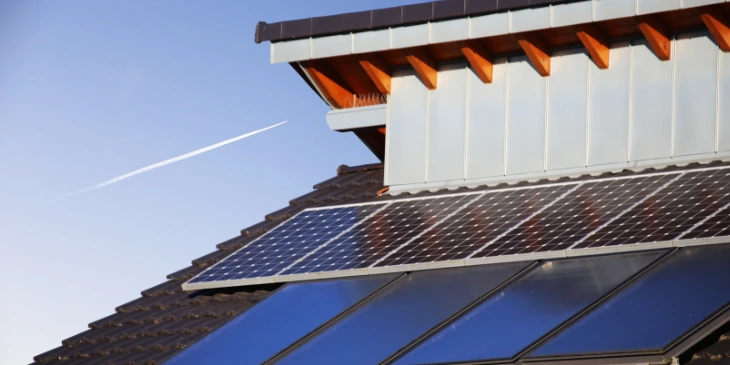
How to Measure Roof Space for Solar
Working out how many panels fit your Edinburgh roof starts with measuring the usable surface area that gets good sunlight. This means south-facing (or east/west-facing) sections, excluding heavily shaded spots.
For a rectangular roof section, measure the length and width, then multiply for area. Do this for each roof plane you'll use and add them together. You typically wouldn't use north-facing sides in Edinburgh given our northern latitude. Subtract areas around obstructions and leave buffer space near roof edges. What remains is your net usable area for panels.
Once you've got the area, estimate how many panels fit by dividing by one panel's area. A typical panel is roughly 1.7m by 1m. For quick calculations, use around 2m² per panel. If you've got 50m² of unshaded roof space, you could fit roughly 25 panels.
Digital tools can also help measure roof space. Online solar calculators using satellite imagery estimate your roof's area, automatically factoring in orientation and shading patterns.
If you have a 40m² south-facing roof, dividing appropriately suggests approximately 23 panels could fit. Final layouts should always be confirmed by professional surveys arranged through Solar Panels Edinburgh, but this gives you a ballpark figure to work with.
How Many Panels Can Fit on a Typical UK Roof?
How many panels physically fit versus how many you should fit are different questions. Here we'll address the physical capacity of average Edinburgh roofs.
UK homes tend to be more compact with limited roof surface area compared to other countries. Average three-bedroom house roofs can hold 10-20 panels maximum. This assumes you might use both slopes of pitched roofs.
UK installers must leave at least 20cm gaps to roof edges, plus around 15cm between rows. These gaps reduce how many panels fit. Fitting 12-16 panels on one roof face is often achievable on decent-sized detached houses in West Edinburgh or Morningside, whereas small terrace roofs in densely built areas might only accommodate 6-8 panels.
A typical 4kW home solar system requires about 12-16 panels, needing roughly 20-30m² of roof area. Many Edinburgh semi-detached or terraced homes have 20-30m² of good south-facing roof available.
For typical Edinburgh homes, expect 6-14 panels in standard installations, with 10-12 panels (around 4kW) very common on 3-bed semi-detached properties.
How Many Solar Panels Do You Actually Need?
From an Edinburgh homeowner's perspective: how many solar panels do you actually need? This depends primarily on your household energy consumption.
Average UK households use about 2,900 kWh per year for electricity. For typical usage, roughly 8-12 panels suffice for average Edinburgh homes. Average Edinburgh 3-bedroom homes might install around 4kW of solar (10-12 panels) producing roughly 3,000+ kWh annually.
For one-bedroom flats in areas like East Edinburgh, 4-6 panels could fit the bill, whereas large 5-bedroom homes in outlying areas with high usage might need 14-20 panels.
To determine your needs, check annual electricity usage in kWh on utility bills. Calculate system size (kW) needed by dividing annual kWh by typical annual kWh production per kW of solar in your location. If you use 4,000 kWh per year and 1kW of solar yields roughly 850 kWh per year in Edinburgh, you'd need approximately 4.7kW of panels.
Common guides simplify this with equations. In the UK, our cloudier climate means each watt of solar capacity produces around 0.85-1.0 kWh yearly. A 400W panel in Edinburgh might produce about 400-450 kWh per year.
You don't necessarily need to cover 100% of consumption with solar. Many Edinburgh homeowners size systems to provide large chunks of usage, but not exceed it. Unless you have solar battery storage or plan for future higher usage, extra panels may not give good returns.
The optimal number of panels meets your needs without huge surplus. For quick estimates: each 1kW of solar (about 2-3 panels) generates roughly 800-1,000 kWh yearly in Edinburgh. Consider roof space and budget. You may scale down if your roof can't fit the theoretical number.
Solar is modular. You can start with panels covering a portion of needs and add more later, assuming your inverter and grid connection can accommodate expansion.
Final Thoughts on Sizes and Solar Panels
Sizing solar panel systems balances roof physical limits with energy requirements and budget. Panels come in standard sizes and have grown more powerful over time.
If you have a small roof in a conservation area, opt for high-efficiency panels producing more watts per square metre. If your roof is huge, you likely won't need all of it. Size systems to your need, not just available space.
Solar investments are long-term. Consider future needs like electric cars or electrifying heating. Ensure your roof is in good condition before installing, particularly important for Edinburgh's traditional slate roofs.
Get professional assessments. Qualified solar surveyors measure your roof, check orientation and shading, and propose optimal panel layouts. Solar systems are fantastic for saving on bills and improving home sustainability, whilst respecting Edinburgh's architectural heritage.
Understanding typical panel sizes, roof limitations, and how to calculate panel needs equips you for informed discussions with installers. Maximise sun, work within roof constraints, and size systems smartly for needs.
Ready to explore whether solar panels fit your Edinburgh roof? Get in touch for free site surveys. For ongoing support, Solar Panels Edinburgh can connect you with maintenance professionals to keep your system performing optimally.

FAQs on Solar Panels and Roofs
How big is a standard solar panel?
A typical residential PV panel is about 1.6-1.8 metres tall and roughly 1 metre wide, around 1.7-2.3m² in area. These panels weigh between 18-25 kilograms. High-wattage panels (400W+) tend toward larger dimensions. Average panels today are around 2m² and 400W capacity.
How much roof space is needed for a typical solar system?
About 5m² per 1kW of solar. A standard 4kW domestic system (around 12-16 panels) requires roughly 20m² of clear roof space. Higher wattage panels need fewer panels and slightly less area.
Can my roof support the weight of solar panels?
Yes, most likely if structurally sound. Panels add about 10-12kg per square metre. In Edinburgh, most roofs handle solar arrays easily, with load capacity around 108 kg/m². If your roof is old or damaged, have installers inspect it, particularly for traditional slate roofs common in conservation areas.
Does my roof have to face south for solar panels to work?
No, but south is best. South-facing roofs get most sun, yielding maximum energy. Southeast or southwest faces are still very good. East or west-facing roofs produce around 15-25% less energy but you can compensate by adding extra panels to fit.
Do I need planning permission to install solar panels?
In most cases, no. UK residential solar panels are generally "Permitted Development." Main rules are panels shouldn't protrude more than 200mm from roof surfaces. For most Edinburgh homeowners, installing modest arrays on standard pitched roofs is pre-approved. However, properties in conservation areas or the UNESCO World Heritage site may require additional permissions, so check with your local planning authority.
How long do solar panels last on a roof?
Quality solar panels typically carry 25-year warranties and often last 30 years+ in service. After 25 years, panels might still produce roughly 85% of original output.
What if my roof can't fit all the solar panels I want?
Use higher-wattage panels (450W or 500W instead of 300W) so each panel produces more. Utilise multiple roof facets (both front and back of pitched roofs). Consider mounting options like garages or ground-mounted racks if you have garden space.
Is there a maximum number of solar panels I'm allowed?
Legally, there's usually no hard limit on panel numbers. Systems above certain sizes may need extra approvals. Any system larger than 3.68kW per phase requires informing Distribution Network Operators and getting permission.
Will solar panels damage my roof or cause leaks?
Properly done installations shouldn't damage roofs. Panels mount using brackets attached to roof rafters, with penetrations sealed with flashing. Our accredited installers ensure attachments are watertight and appropriate for Edinburgh's slate roofs and weather conditions.